Art, AI, and the Context of Innovation: My time at Data Science Law Lab, University of Pretoria
For the past four months, I have had the incredible opportunity to work as a Research Fellow with Open AIR’s Canada–Africa Partnership on Intellectual Property (CAP on IP) for Climate Action Fellowship. As part of the fellowship, I spent just over five weeks in South Africa working with collaborating research hubs at the University of Cape Town, the University of the Western Cape, the University of Johannesburg, and the University of Pretoria.
Understanding the CAP on IP Project
The CAP-on-IP project is a multi-year research project examining how intellectual property systems influence the development and diffusion of clean technologies across Canada and Africa. At its core is an important question: how can intellectual property systems help, rather than hinder, the development and equitable adoption of the technologies needed to address climate change? These technologies are governed by legal and policy systems designed for very different circumstances. CAP on IP therefore seeks to examine the assumption that more intellectual property protection necessarily produces more innovation.
Over seven years, it aims to identify and reduce IP barriers so clean technologies can be developed efficiently, effectively, and fairly across contexts, through eight multidisciplinary case studies that consider the technologies themselves alongside the legal, policy, economic, and social environments in which they are developed and deployed.
My own research has primarily focused on carbon capture and storage (CCS) in Canada, but I have also explored broader questions surrounding intellectual property, trademarks, greenwashing, artificial intelligence, and climate action. Pretoria offered an opportunity to consider those questions from another perspective: what happens when we think about innovation not only as the creation of something new, but also as the preservation, adaptation, and sharing of knowledge that already exists?
Discovering the University of Pretoria and learning through South African Art
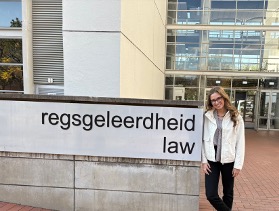
My introduction to UP came through a scenic tour of the Hatfield Campus, beginning at the Faculty of Law, with its open-concept design, which is unfortunately uncommon in Canada, and at the historic Old Arts Building. But the highlight of my visit was undoubtedly the Javett-UP Art Centre.
Walking through the Javett-UP was a surreal experience: such an expansive and beautiful collection of art located right on campus truly emphasises the importance of art within the academic experience. What struck me was the importance of context. Art carries the history and perspective of the people and communities who create it. Understanding that context changes how the work is interpreted and, in turn, how its knowledge and meaning are preserved and shared. This resonated unexpectedly strongly with the questions I have been exploring through CAP on IP.
Intellectual property systems are, at their core, systems for regulating knowledge, creativity, ownership, and dissemination. But knowledge does not exist independently of the people, cultures, and environments from which it emerges. The experience encouraged me to think more critically about what can be lost when knowledge is removed from its context.
From Art to Artificial Intelligence
My academic work at the University of Pretoria also took me in a very different direction: artificial intelligence, climate disinformation, and intellectual property. I worked on an update examining the evolving relationship between the three, my first exposure to the AI and IP space.
Much of the discussion surrounding AI and the environment has focused, rightly, on the technology’s direct environmental footprint. Another dimension deserves attention: how AI can influence the information environment in which climate decisions are made. AI can contribute to the creation and dissemination of false or misleading information, amplifying climate disinformation at a scale and speed difficult to achieve otherwise. Businesses can inadvertently contribute when AI-generated content enters marketing or environmental claims without sufficient oversight. This is particularly relevant in Canada given the country’s new anti-greenwashing provisions, which place greater importance on substantiating environmental claims and on the use of “green” trademarks that could mislead consumers.
AI could accelerate the diffusion of clean technologies, but it could also create new barriers, distort information, facilitate misleading environmental claims, or complicate existing approaches to ownership and attribution. Understanding both possibilities will be important to ensuring that technological innovation actually contributes to meaningful climate action.
What I’m Taking Away from Pretoria
The Javett-UP showed me the importance of culture and context in preserving knowledge; my work on AI and climate disinformation highlighted how rapidly those systems are changing. Most importantly, Pretoria reminded me that context is not secondary to innovation, it is part of it. Whether we are talking about a work of art, a piece of legal scholarship, an emerging technology, or knowledge developed within a community, understanding where that knowledge comes from and how it is shared can fundamentally change how we understand its value and impact.
Thank You, Pretoria
I am incredibly grateful to Professor Chijioke Okorie for hosting me through Dr. Hamza Monkaree, who introduced me to the University of Pretoria and to so many amazing people (members of the Data Science Law Lab) who made me feel welcome during my stay. Everyone went above and beyond to ensure I had a strong sense of the amazing work happening at UP, as if I were a student myself. I equally enjoyed Dr. Monkaree’s lecture on copyright.
I am also grateful to Open AIR, the University of Ottawa, and the Canadian CAP on IP team for supporting this opportunity to explore these questions in an international setting.
~written by Emma Arnew (J.D. 2028 candidate, University of Ottawa)