Perspectives from the Deep Learning Indaba 2024 #3: Navigating AI Innovation and Licensing in Africa
Some of the members of Data Science Law Lab were at the Deep Learning Indaba 2024 held in Dakar, Senegal in September 2024 and have shared their perspectives on various discussions at the Indaba. Takudzwa Matekwe, an LLM student at the University of Pretoria was one of them. Takudzwa shares his perspectives on Dr Okorie’s presentation on “Navigating Licensing for AI Innovation In Africa”.
Here’s what Takudzwa says:
By Takudzwa Matekwe
Artificial intelligence (AI) is reshaping industries and societies globally, and Africa is no exception. The continent has made significant strides in AI research and development, driven by its unique data ecosystem and the growing need for technological innovation. However, a critical aspect often overlooked in these discussions is the importance of data licensing, particularly open data licensing, to facilitate AI growth on the continent. As AI continues to mature in Africa, understanding how to license datasets becomes essential for creating equitable access and fostering innovation.
The Importance of AI Datasets and Licensing
AI thrives on data, and in Africa, the availability of diverse and representative datasets is crucial for developing robust AI models. Datasets in AI consist of collections of related data organized for a specific purpose, often tied to an identifiable entity or person. These datasets are the backbone of AI applications, enabling machine learning algorithms to learn patterns, make predictions, and generate insights. However, the use of these datasets comes with legal and ethical considerations, particularly around who can access, modify, and share the data. Licensing serves as the mechanism through which these permissions are managed, making it a critical component of AI innovation.
In the African context, the conversation about licensing extends beyond mere legalities to include issues of access, ownership, and ethical use of data. The continent’s unique challenges, such as limited infrastructure, and differing legal frameworks, make licensing a particularly important topic. Therefore, African researchers and innovators must navigate these licensing frameworks to ensure they can both contribute to and benefit from global AI developments.
The African AI Landscape: Challenges and Opportunities
Datasets are characterized by their heterogeneity, and in the African context, reflect the continent’s rich cultural, linguistic, and socioeconomic diversity. This diversity presents both opportunities and challenges for AI researchers and practitioners working on the continent. One of the primary hurdles faced by African researchers is navigating the complex web of legal frameworks governing data use and sharing.
Siminyu et al highlight the significance of community agency in the creation and use of datasets. Their study revealed that datasets generated by African researchers are frequently shared without proper credit or regard for the communities that contributed to the data. The current licensing frameworks when applied to or used by African data scientists, researchers, and social entrepreneurs often fall short of safeguarding the privacy, agency, and socioeconomic rights of individuals and communities. Despite being labelled “open,” these licenses can lead to “data laundering,” where datasets are commercially reused without providing any benefit to the original data sources or researchers, ultimately exploiting the good intentions of open licensing to the disadvantage of most African communities. This underscores the need for more robust licensing frameworks that protect the rights of both researchers and the communities they work with.
Access to infrastructure also remains a barrier. Many African researchers lack the computing resources needed to process large datasets or run complex AI models. This creates a situation where access to data is not just a matter of legal rights but also one of infrastructure and resources. Thus, while AI has the potential to bring about transformative change in Africa, it must first overcome these structural challenges.
Despite these hurdles, African researchers are increasingly playing a dual role in the AI ecosystem—as both licensees (users of datasets) and licensors (creators and sharers of datasets). This dynamic is crucial for the continent’s AI growth. African researchers need access to global datasets to train their models, but they are also key contributors, generating valuable datasets from African contexts that can enhance global AI models.
Legal and Ethical Considerations in AI Licensing
Copyright laws could prohibit the unauthorised reproduction, adaptation, and distribution of data where such data consist of copyright-protected works or, themselves meet the eligibility criteria for copyright protection. This can hinder collaboration, slow down scientific progress, and limit the development of new technologies. In addition, copyright laws in African countries can vary significantly, which creates challenges when attempting to share datasets across borders.
Ownership of datasets is another critical issue. Who owns the data, and who has the right to use it? In some cases, the researchers or organizations that collect the data retain ownership, while in others, the communities from which the data was collected may claim a stake. Balancing the need for open data with the rights and agency of these communities is essential to ensure that AI development in Africa remains ethical and just.
Researchers must also consider issues related to indigenous knowledge and the protection of personal information. In many cases, data collected from African communities may include sensitive information that requires special handling to ensure privacy and community protection.
Many African countries are still developing their data protection frameworks, which means that researchers must be aware of both local and international regulations when working with datasets. For example, South Africa’s Protection of Personal Information Act (POPIA) imposes strict requirements on how personal data can be collected, stored, and used, which may impact AI projects that rely on sensitive data.
Open Data Licensing for African Datasets
One promising solution to the data access problem in Africa is the adoption of open data licensing, offering a framework for more equitable access to African datasets. Standard open licenses such as Creative Commons (CC) licenses and Open Data Commons (ODC) licenses provide researchers with clear guidelines and conditions to freely use and share data. CC licenses such as the CC-BY, CC-BY-SA and CC-BY-NC allow for free use and distribution of data, provided proper attribution is given to the original creator. Similarly, the ODC Licenses such as ODbL and ODC Attribution License which are specifically designed for databases and datasets, offer terms that are similar to those of certain Creative Commons (CC) licenses. These licenses operate on both the input and output sides of AI projects. On the input side, they allow researchers to access and use datasets for training their models. On the output side, they provide clarity on how the results generated from these datasets can be shared, reused, and built upon. Therefore, CC licenses make it easy to share and use factual data, like statistics or geographical information, without worrying about copyright issues.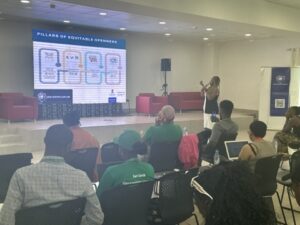
However, the adoption of open data licenses in Africa is not without its complexities. Researchers must carefully consider the implications of different license types on both the input and output sides of their AI projects. On the input side, they must ensure they have the necessary rights to use and modify existing datasets. On the output side, they must decide how to license their own datasets and AI models to promote further innovation while protecting the interests of their communities and institutions.
Moreover, CC licenses can lead to the problem of attribution stacking. When combining Creative Commons-licensed works, attribution requirements can become overly complicated and lengthy. This can limit reuse and create barriers due to excessive crediting. Furthermore, the non-commercial use condition restricts commercial use, potentially limiting revenue and innovation. Also, the ShareAlike condition forces derivative works to use the same license, which could limit compatibility with other licensed materials. This can reduce the value and flexibility of shared work. Lastly, the No Derivatives condition severely restricts reuse by prohibiting adaptations and modifications. This limits creativity and innovation, reducing the value of shared work.
Bridging the gaps: The Future of Open Licensing in African AI
To address the abovementioned challenges, the Nwulite Obodo Open Data License has been developed as an alternative that ensures equitable, transparent, and community-oriented data use. This new license framework emphasizes benefit-sharing, attribution, and the protection of the rights of African communities, making it a more suitable option for the equitable open licensing of African language datasets. The Nwulite Obodo Open Data Licence is a significant victory for African and other developing communities. The license ensures proper acknowledgement of all contributors to prevent disputes and guarantee fair recognition or compensation. It covers copyright, ownership, possessory and custodial rights of African (language) datasets, empowering creators, and licensors to protect their work while fostering collaboration. It is guided by the spirit of ubuntuwhich encompasses community, solidarity, and shared growth.
Conclusion
In conclusion, as AI continues to evolve in Africa, navigating the intricacies of data licensing is crucial for ensuring equitable and inclusive growth. The continent’s unique data ecosystem, characterized by its diversity and resource challenges, presents both opportunities and obstacles for AI innovation. Open data licensing offers a pathway to democratize access to data, allowing African researchers to contribute to and benefit from global AI advancements. However, the current frameworks often fall short of protecting the rights of African communities and ensuring fair usage of local datasets. With initiatives like the development of Africa-specific licenses such as the Nwulite Obodo Open Data License, there is hope that these gaps will be bridged, fostering more equitable participation in the global AI landscape. For Africa to fully harness the potential of AI, it must continue to develop robust, ethical, and inclusive licensing frameworks that respect the agency of its communities while driving innovation across sectors.