Gathering what was scattered: Reflections on the UP-led Panel on Lovedale Press
The Lovedale Press Colloquium, hosted by UNISA in collaboration with the Thabo Mbeki Foundation on 11–12 November 2026, asked whether the publishing house that brought African writers, and works in African languages, into print can have a future. Day 1 looked back. In his keynote, Emeritus Professor André Odendaal argued that Lovedale was never just a printing business but a place where African writers, ideas and political thought were recorded and shared, and where isiXhosa writing and indigenous knowledge were preserved. The day’s discussions of literature, archives and African-language publishing made the case that the Press, and the record it holds, are worth reviving.
Day 2 asked what that would take. Athandiwe Saba opened the University of Pretoria’s panel with a blunt question: “What exactly are we trying to save?” A publishing house, a collection of books, a business, or knowledge itself? By the end of the panel, we were convinced that Lovedale’s problem is less scarcity than fragmentation: its works, rights, archives and supporters are scattered across owners, formats and institutions.
A panel designed across disciplines
The panel was conceptualised and organised by Prof Chijioke Okorie, PI of the Data Science Law Lab (DSLL). It rested on a premise we came to share: Lovedale’s problems cannot be solved one discipline at a time. Prof Okorie brought together voices that rarely share a stage: UP Copyright Officer Zama Khanyile, insolvency and business rescue scholar Dr Shammah Boterere, and digitisation specialist Lidia Swart of the UP Library, with Ms Saba, an investigative data journalist and AI, media and data strategist, as moderator. The design paid off. Each answer exposed a condition for the next: digitisation depends on copyright clearance, copyright depends on knowing who owns what, and ownership means little if the Press cannot survive its finances.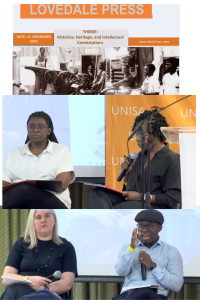
Rights come before scanning
Ms Khanyile’s point sounds simple but carries the whole project: Lovedale cannot protect, license or digitise works it cannot find. Its publications and papers are scattered, and the rights in each work must be traced through authors, contracts and heirs. Some works will be in the public domain. Others, whose rights holders cannot be found, will still be protected and need careful handling. Ms Swart made the same point from the library: scanning is only about 10% of digitisation. The rest is copyright clearance, metadata, master and access copies, and storage that will still be readable in a hundred years, with scanners alone costing between R500 000 and R4 million. What we took from both is that the unglamorous groundwork of inventories, rights records and metadata is not preparation for the revival. It is the revival.
Separating the heritage from the business
Dr Boterere offered the most concrete proposal of the day. He argued that Lovedale’s decline is structural: a small private company has been asked to carry the cost of national heritage. His answer is to unbundle it. A non-profit trust would own the intellectual property, while a separate company would print and publish under licence. If the business failed again, the literary works would be ring-fenced from its creditors. Morija in Lesotho, where the printing works and the museum and archives are separate entities, offers a precedent close to home. A non-profit could also open doors to public funding and tax-deductible donations that a private company cannot. The harder question, which Ms Saba rightly pressed, is accountability. Dr Boterere proposed a board of trustees with a permanent seat for Lovedale’s worker-owners alongside partner institutions. That idea deserves careful design before anyone commits to it.
Open, but not for the taking
The sharpest tension of the session was between access and extraction. Everyone wanted Lovedale’s works freely available to schools, libraries and researchers. Yet once digitised, African-language texts become valuable training data for large language models and translation tools. Ms Khanyile’s answer was licence terms that state clearly who may use the works and for what, including whether they may be uploaded to AI tools, backed by infringement notices. Ms Swart added that AI can help draft metadata but cannot be trusted without human review. In our view, licence terms are necessary but not sufficient. They are only as strong as the ability to enforce them, often against developers outside South Africa. Legal design has to be matched by technical design: what goes online, in what form, and behind what access controls. These are the questions DSLL works on, and Lovedale is a case worth following closely.
What the room added
The floor pushed the conversation from design to durability. A choral music specialist transcribing works from tonic solfa into staff notation asked what happens to such projects when the specialist leaves. Another participant noted that Fort Hare, UNISA, UP, UCT and Rhodes have each archived Lovedale material over decades, in different ways, and called for those efforts to be consolidated. Bongani Kupe of the Thabo Mbeki Foundation made the same case, citing the economist Albert Hirschman on development as the work of enlisting resources that are hidden, scattered or badly utilised. The Foundation, he said, wants the project to happen but does not want to own it.
Gathering what was scattered
Scattered works, scattered rights, scattered archives, scattered efforts: the same idea kept returning, from copyright to insolvency to the Foundation’s closing remarks. That is why the panel’s design mattered. By bringing law, finance, librarianship and journalism into one conversation, Prof Okorie’s panel did on a small scale what Lovedale’s revival will require at scale: gathering what is scattered and making it work together. Its insights will feed into the post-colloquium report, and the full Day 2 proceedings can be watched here.
~Written by Zinzi Shabangu and Abimbola Modupe